
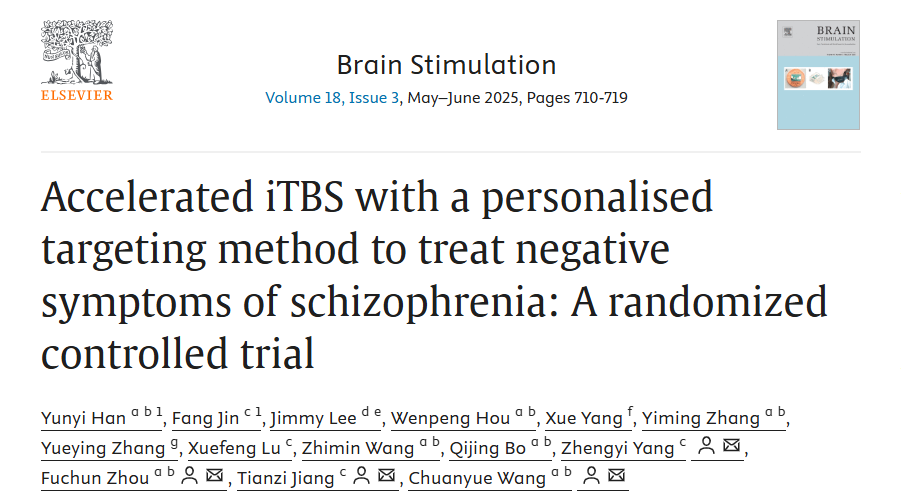
Accelerated iTBS with a Personalised Targeting Method to Treat Negative Symptoms of Schizophrenia: A Randomized Controlled Trial
Schizophrenia is a severe mental disorder characterized by positive symptoms, negative symptoms, and cognitive dysfunction. Negative symptoms (such as anhedonia, avolition, asociality, blunted affect, and alogia) are associated with high disability rates. Current pharmacological treatments have limited efficacy against these symptoms. As a non-invasive brain stimulation technique, repetitive transcranial magnetic stimulation (rTMS) shows potential in improving negative symptoms, but its therapeutic effects remain inconsistent.
Research Method
Research Subject
80 patients with schizophrenia meeting DSM-5 criteria and predominantly negative symptoms (PANSS negative subscore ≥21, with at least one item ≥4; positive subscore <19).
Patients were randomized into an active group (n=40) and a sham stimulation group (n=40) using a double-blind controlled design.
Intervention Plan
Accelerated iTBS: Four sessions per day (with 50–60 minute intervals) over 10 days (totaling 40 sessions), each delivering 1,800 pulses (cumulative total of 72,000 pulses).
Personalized Target Localization:
Resting-state functional magnetic resonance imaging (fMRI) was used to calculate the functional connectivity (FC) strength between the individual's left dorsolateral prefrontal cortex (dlPFC) and the ventral tegmental area (VTA);
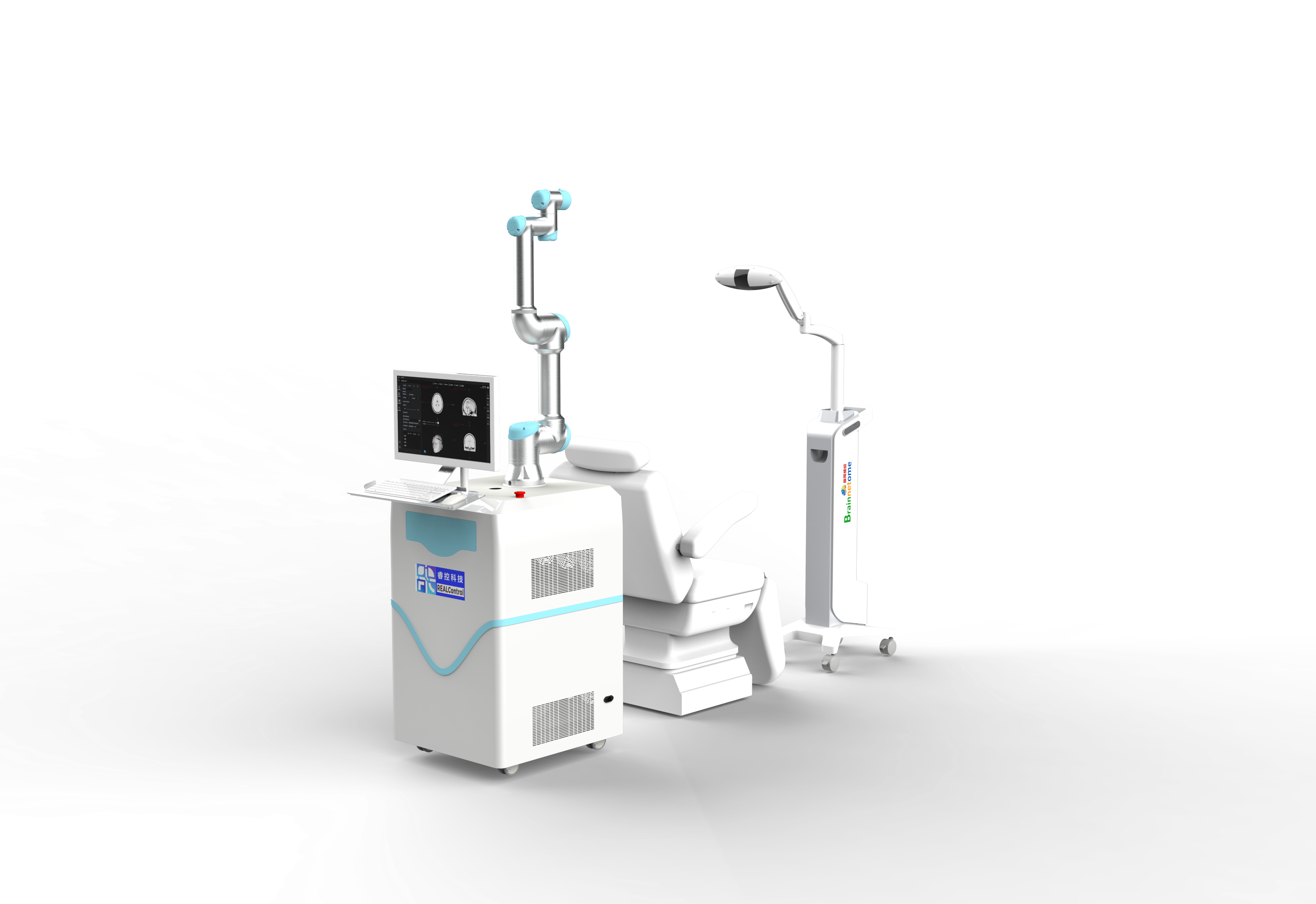
The dlPFC region with the highest FC strength was then precisely targeted for stimulation at 90% of the resting motor threshold (RMT) using a neuro-navigation robot (RC-M2N2-Duet).
赣械广审(文)第271211-05240号
The sham stimulation group used a sham coil identical in appearance, which produced no magnetic field output.
Evaluation Metrics
Primary Outcome:Change in PANSS Negative Subscale (PANSS-NS) score at Week 4.
Secondary Outcomes:Clinical Scales (SANS、CGI-S、PSP)、Cognitive Function (MCCB) and Neuroimaging (fALFF、FC) change。
Research Results
Significant Improvement in Negative Symptoms
The active group showed a significantly greater reduction in PANSS Negative Subscale (PANSS-NS) scores at Week 4 compared to the sham stimulation group (mean difference = 4.10, p < 0.001, Cohen's d = 0.83), with this treatment effect persisting through Week 12 (p < 0.01).
Response Rates (improvement ≥ 20%): Active Group vs. Sham Stimulation Group
Week 4: 77.5% vs. 17.5% (OR = 16.24, p < 0.001)
Week 12: 65% vs. 25% (OR = 7.22, p < 0.001)

Figure 1. Response Rates at Different Visits for the Active and Sham Surgery Groups
Improvement in Key Symptom Domains
A significant improvement was observed in the blunted affect domain of the Scale for the Assessment of Negative Symptoms (SANS) (p=0.004), with enhancements in avolition and anhedonia also evident by Week 8.
Concurrently, global functioning (Clinical Global Impression-Severity scale, CGI-S) and social functioning (Personal and Social Performance scale, PSP) showed synchronous improvement (p=0.006)
Changes in fALFF and FC Following iTBS Intervention
Suppression of Left Middle Temporal Gyrus (MTG) Activity: The active group exhibited a significant decrease in the fractional amplitude of low-frequency fluctuations (fALFF) in the left MTG (p < 0.05). This reduction was negatively correlated with the improvement in PANSS Negative Subscale (PANSS-NS) scores (r = -0.29, p = 0.01) .
Remodeling of the VTA-Prefrontal Circuit:
The functional connectivity (FC) between the ventral tegmental area (VTA) and the left MTG was weakened (r = -0.34, p = 0.003), and this change was associated with symptom improvement
The FC between the VTA and the left middle frontal gyrus (MFG) was enhanced, which was linked to the alleviation of blunted affect.
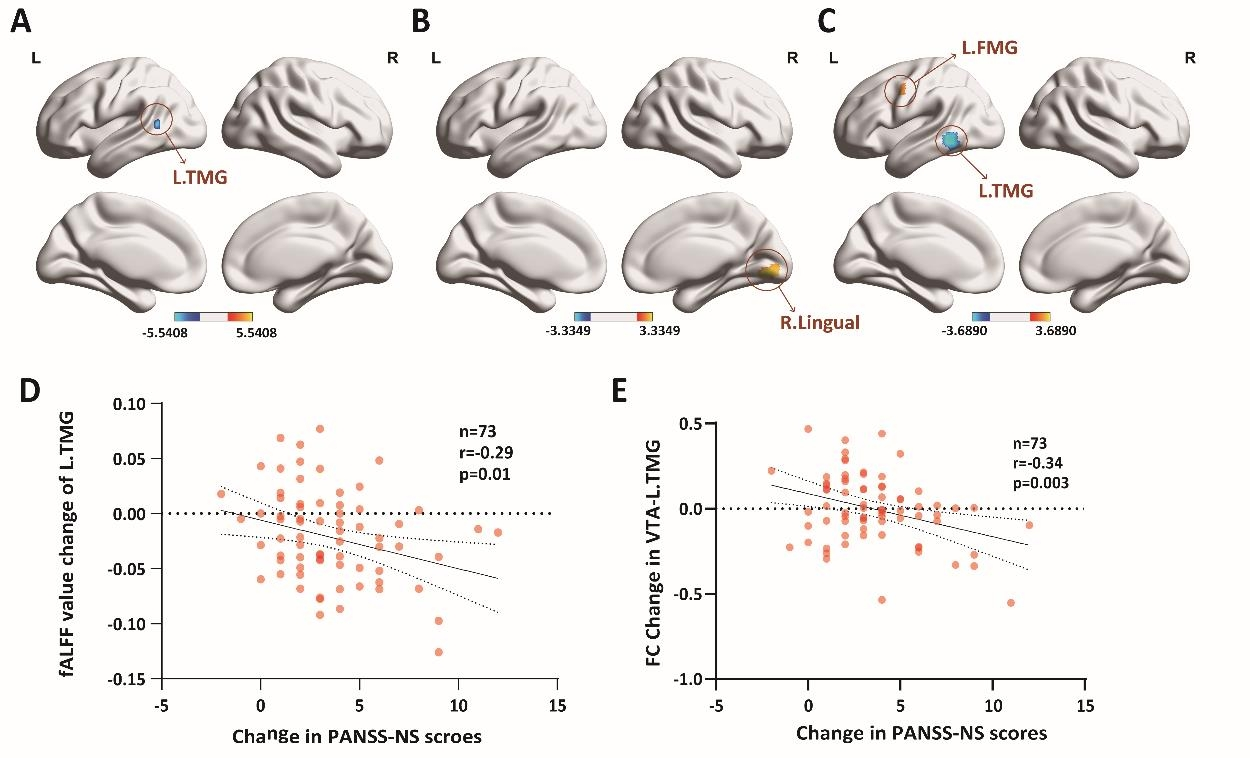
Figure2. Neuroimaging Findings and Their Correlation with Changes in PANSS Negative Symptom Scores
Research Conclusion
Accelerated iTBS with a personalised targeting method significantly improved the negative symptoms of schizophrenia, particularly alleviating affective flattening and enhancing social function. These improvements may be associated with the enhancement of functional connectivity (FC) within the mesocortical circuit and the reduction of connectivity with the middle temporal gyrus. Notably, this therapy demonstrated good tolerability and a favourable safety profile. The study findings provide an innovative, evidence-based, and personalised treatment option for addressing the negative symptoms of schizophrenia
1. Complied by Puzoo Medical. Suggestions are welcome. Source attribution required.
2. Reference:Han, Y., Jin, F., Lee, J., ... , Wang, C. (2025). Accelerated iTBS with a personalised targeting method to treat negative symptoms of schizophrenia: A randomized controlled trial. Brain Stimulation. https://doi.org/10.1016/j.brs.2025.03.014
- Prev:No More
- Next:No More