Eye-Tracking System
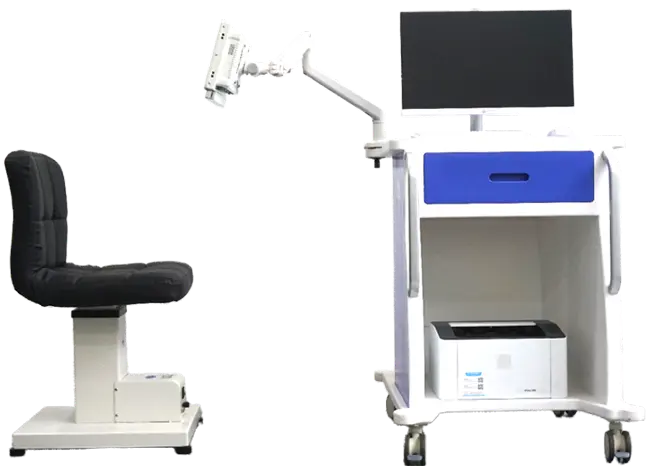
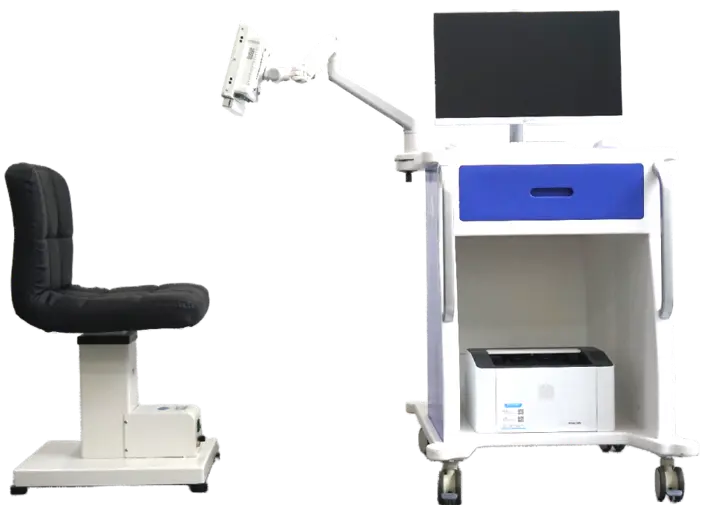
The eye movement detection system is an objective detection device independently developed by Gengnao Medical in collaboration with Puzhuo Medical, catering to the clinical screening needs of psychiatry and neurology. Utilizing fully non-contact infrared tracking technology, the system can record the eye movement trajectory and pupil size changes of the subject in real-time without requiring a fixed head position. It completes eye movement trajectory analysis, pupil size analysis, and quantitative report output through dedicated software. The product consists of an eye movement detection sensor, a computer all-in-one machine, a secondary display, dedicated software, and a power adapter. The doctor's terminal and the subject's terminal are integrated into the same vehicle, featuring a dual-screen design with a primary and secondary screen, and electric adjustable desks and chairs to accommodate different subject positions. The system is equipped with built-in smooth trajectory tracking, directional/reverse saccades, and exploratory eye movements (EEM) examination tasks, while supporting custom research paradigms and experimental designs. It caters to both clinical screening and scientific research needs, providing clinicians with reference for the diagnosis and screening of schizophrenia and Alzheimer's disease (AD).
videoProduct Advantages

Non-contact infrared, non-invasive and comfortable
Fully non-contact infrared tracking/detection, without the need to fix the head position, allows the subject to complete the examination in a natural state, resulting in higher compliance

"Sub-degree accuracy · Stable sampling"
Sampling rate ≥ 110Hz, measurement error of pupil diameter and position both ≤ 4%, unilateral jitter rate ≤ ±0.4° (visual angle) / 15 seconds, ensuring data authenticity and reliability

Multi-paradigm tasks · Balancing clinical research and scientific research
Built-in tasks such as smooth trajectory tracking, saccade/vergence, and exploratory eye movement (EEM) exploration, supporting custom research paradigms and free experimental design

Intelligent analysis · One-click report
Automatically outputting quantitative metrics such as NEF, TESL, MESL, RSS, etc., generating fixation location maps, curve charts, and heat maps, supporting multiple result comparisons and exporting raw data
What is eye-tracking technology?
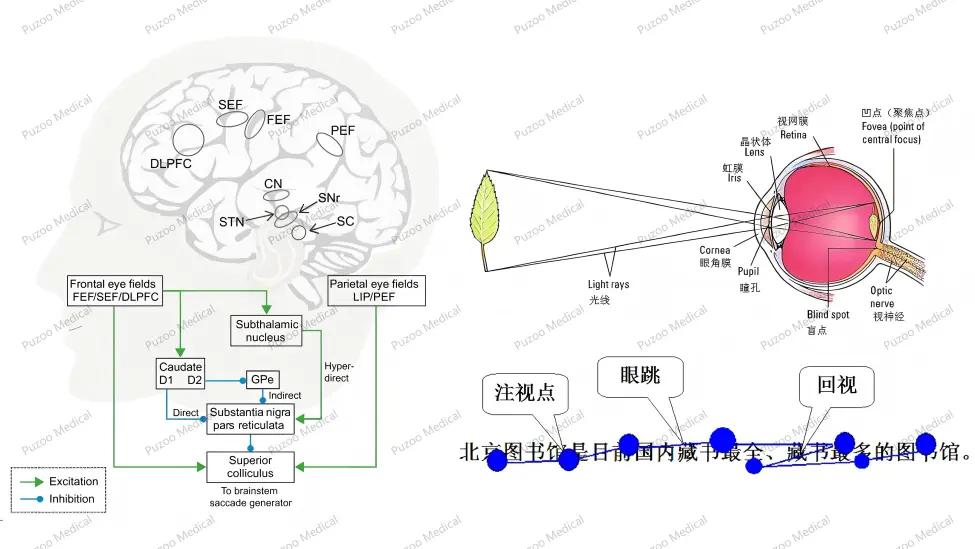
Eye movement detection is a technology that utilizes infrared optical sensors to continuously record the trajectory of eye movements and changes in pupil size without contacting the human body. The three basic types of eye movements, namely fixation, saccade, and smooth pursuit, are driven by cognitive processing processes such as attention, memory, and executive function. Their trajectory characteristics and pupil responses can be objectively quantified. Therefore, eye movements serve as a "window" for observing brain cognitive functions - the examination process is non-invasive, non-radiative, and does not require active response and cooperation from the subjects.
In the field of psychiatry, exploratory eye movement (EEM) is an objectively validated physiological indicator: when subjects view specific graphics and answer "Is there anything else different?", their number of fixation points (NEF), total eye scanning length (TESL), mean eye scanning length (MESL), and response search score (RSS) exhibit characteristic changes. Public research shows that patients with schizophrenia generally exhibit reduced fixation points, shortened scanning length, and decreased RSS scores, and these abnormalities persist after symptom remission, unaffected by medication, disease duration, and demographic characteristics. They are considered a stable biological marker that can also be detected in healthy first-degree relatives, providing value in identifying high-risk individuals. Pupil response is closely related to cognitive load and central nervous system regulatory function, providing objective clues for the early identification of neurodegenerative diseases such as Alzheimer's disease.
This product is designed for medical institutions to record eye movement trajectories and changes in pupil size, providing a reference for clinicians in the diagnosis and screening of schizophrenia and Alzheimer's disease (AD).
High-precision eye tracking
High sampling rate to fully capture saccades: With a sampling rate of ≥110Hz, it fully records rapid saccades and minor fixation drifts, providing a data foundation for detailed eye movement analysis
Dual high-precision pupil measurement: pupil diameter measurement error ≤4%, pupil position measurement error ≤4%
Extremely low jitter and long-term stability: Single-sided jitter rate ≤±0.4° (visual angle) / 15 seconds, bilateral jitter rate ≤±0.4mm / 15 seconds, no drift detected over a long period of time
Reliable even in low-light environments: The camera has a minimum illumination level of ≥0.1 Lux, adapting to various lighting conditions in different examination rooms
Three pupil positioning monitoring modes: Supporting left eye, right eye, and both eyes modes, which can be flexibly switched according to the subject's condition and examination purpose
Fully non-contact infrared: Utilizing infrared tracking/detection methods, there is no need to fix the head position, avoiding data distortion and subject fatigue caused by a sense of restraint
Integrated design
Integrated doctor's terminal and subject terminal: The doctor's terminal and subject terminal are fixed on the same vehicle, forming a compact integrated design that can be pushed into the examination room for immediate examination
Complete system composition: Consists of an eye-tracking sensor, an all-in-one computer, a secondary display, specialized software, and a power adapter, ready to use out of the box
Dual-screen design for main and auxiliary screens: The main operation screen is 21.5 inches, while the auxiliary inspection screen is 10.1 inches with a resolution of 1280×800. The screens for the doctor and the subject are separated, ensuring no interference between them
Adjustable height and angle of the secondary screen: The secondary screen can be adjusted to any height and angle according to the position of the subject, ensuring image acquisition quality regardless of different heights and sitting postures
Electric Lifting Desk and Chair: The electric lifting desk can be raised or lowered by more than 20cm (manual control), and the electric lifting chair can be raised or lowered by more than 20cm (foot control), suitable for adults, elderly, and subjects with mobility impairments
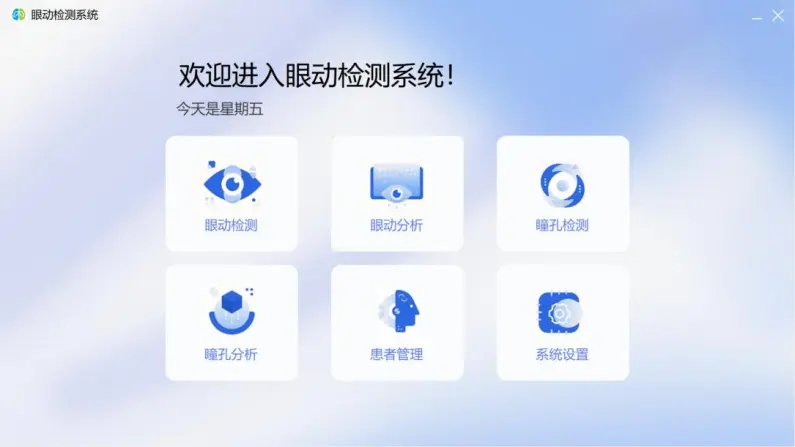
Professional eye tracking software
Four major software modules: including eye movement detection/analysis, pupil detection/analysis, patient management, and system settings, covering the entire examination process
Multiple eye movement examination task paradigms: At least three types of eye movement examination task paradigms, including built-in smooth trajectory tracking tasks and saccade/vergence tasks
Support for EEM Eye Movement Paradigm: Supports task detection for the EEM eye movement paradigm, supports eye movement trajectory analysis and pupil size analysis, and supports data recording and automatic analysis
Real-time visual monitoring: The system displays the left and right pupil images, pupil size change curve graph, working status, and test control in real time, supporting start, pause, end, and single frame marking operations
Eye position monitoring display: The software interface supports real-time display of the eye gaze position and allows for real-time viewing of the original infrared image of the eye, making the acquisition quality clear at a glance
Multi-speed Simulated Playback: Supports 6x, 4x, 2x, normal speed, 1/2x, and 1/4x simulated playback of the detection process, facilitating the examination of changes in the subject's fixation point
Free experiment design: It features experiment design capabilities, allowing for the arbitrary addition of images, text, videos, coordinate point data, and other stimulus materials, with the playback time set freely. It also supports the addition of customized scientific research paradigms
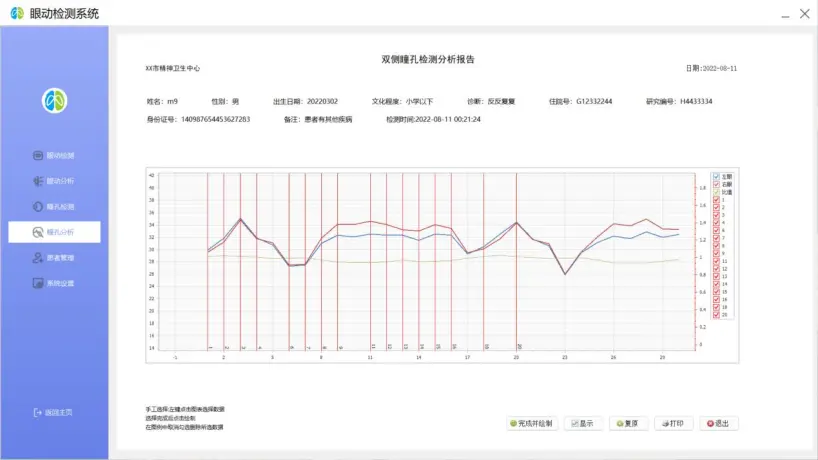
Intelligent analysis and report output
Rich curve analysis functions: including manual curve selection, fixed-point parameter selection, self-selected parameter curve, average parameter curve, and original curve, meeting different needs from rapid screening to in-depth analysis
Standardized quantitative indicators: The test results include NEF (Number of Eye Fixations), TESL (Total Exploration Segment Length), MESL (Mean Exploration Segment Length), and RSS (Reactive Exploration Score)
Gaze Heatmap: Equipped with a gaze heatmap display mode, it visually presents the distribution of the subject's visual attention
Multiple result comparisons: It features a function for comparing multiple examination results and printing a result comparison report, facilitating the tracking of treatment efficacy and disease progression
Automatically Generated Report: The system can automatically generate a report, including quantified detection results, eye gaze point location maps, curve charts, etc
Raw data exportable: Supports the export of raw eye movement data for doctors to conduct customized analysis, serving scientific research and multi-center studies