
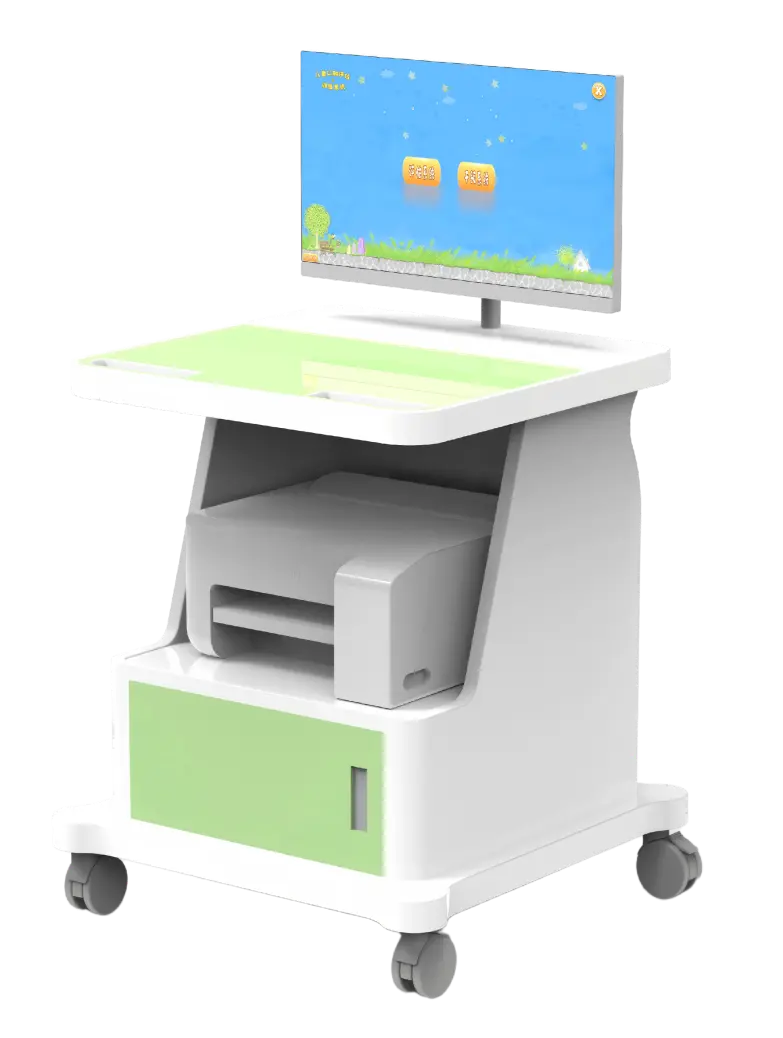
Children's Cognitive Assessment & Training System
The Children's Cognitive Assessment and Training System (Xingweilai) is an innovative learning system developed by Puzhuo Medical to cater to the personalized needs of special children. It serves as a computer-assisted interactive learning platform for the assessment and intervention of childhood autism. By integrating theories of child development and cognitive psychology with extensive clinical practice experience, and incorporating advanced educational information technology, the system employs a dual-track approach combining "assessment games + assessment scales" with gamified training in nine key areas, thereby facilitating better learning and growth for special children. The product models, SFCCRT-W and SFCCRT-WP, have obtained a medical device registration certificate (Ganxiang Zhuanzhun 20262210111), ensuring compliance for clinical use.
videoProduct Advantages

Multimodal dual-track evaluation
Combining gamification assessment with standardized scales, taking into account both children's objective performance and parents' subjective descriptions

Training datasets in nine major domains
Covering dimensions such as social skills, cognitive understanding, and fine motor skills, with a closed-loop process of assessment-recommendation-training

Result visualization and tracking
The evaluation report is presented in graphical form, making historical trends clear at a glance and facilitating longitudinal comparison of training effectiveness

Authoritative team academic endorsement
Derived from the achievements of Professor Chen Jingying's team at the Special Education Informatization Research Center of Central China Normal University
What is the children's cognitive assessment and training system?
The children's cognitive assessment and training system is a type of digital therapy rehabilitation equipment designed for children with attention deficit hyperactivity disorder (ADHD), autism spectrum disorder (ASD), mild cognitive impairment, and cognitive developmental delay. Utilizing computer-assisted interactive learning as a medium, it integrates cognitive ability assessment and rehabilitation training into a gamified environment, enabling children to complete ability evaluation and enhancement through active participation.
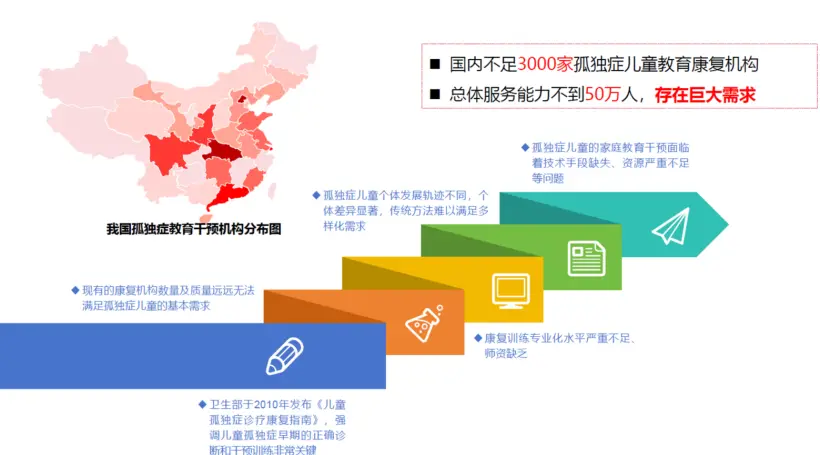
According to public epidemiological research data, approximately 5% to 7% of children globally are affected by Attention Deficit Hyperactivity Disorder, with a prevalence rate of about 6.4% in Chinese children. The prevalence rate of Autism Spectrum Disorder is also on the rise. Conversely, there is an insufficient number of professional rehabilitation institutions, a significant shortage of qualified special education teachers, cumbersome and highly subjective traditional manual assessment processes, and a chronic shortage of diagnosis and intervention resources. Artificial intelligence and educational information technology offer new solutions to this dilemma: enhancing assessment efficiency with standardized tools, reducing children's resistance through gamified training, and enabling measurable and traceable intervention effects through a closed-loop data system.
Multimodal assessment · Game + Scale
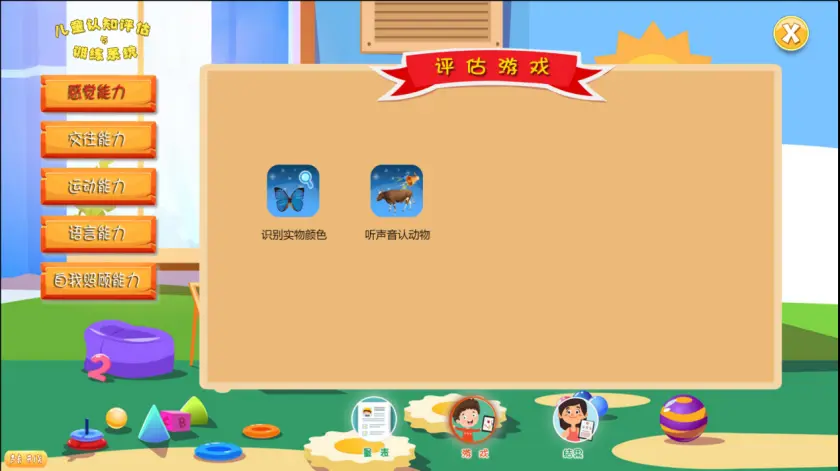
Evaluate games from 5 dimensions
Sensory, social, motor, language, self-care
The game assessment utilizes representative game modules, and based on indicators such as completion time and score, compiles a comprehensive assessment of children's abilities in key areas. For example, in the "Listen to the Sound and Identify the Animal" game, the system plays the sounds of different animals, and children click on the corresponding animal to complete the assessment. By accurately quantifying children's abilities in sound recognition, information comprehension, and environmental perception through "listening to the sound and identifying the picture", the dull assessment is transformed into a fun game experience.
7 major evaluation scales
The scale assessment is conducted and scored by parents or assessors who are familiar with the child's situation. The system automatically calculates the results based on the scores, assessing the severity of the child's suspected autism. Taking the ABC scale as an example, it covers five dimensions: sensation, communication, movement, language, and self-care, quantifying the child's comprehensive cognitive level.
Full-process data traceability
The system comprehensively records relevant data and assessment results throughout the child's assessment process, providing a basis for formulating personalized training plans and also allowing experts to conduct further assessment and analysis.
Nine major training project libraries · personalized solutions
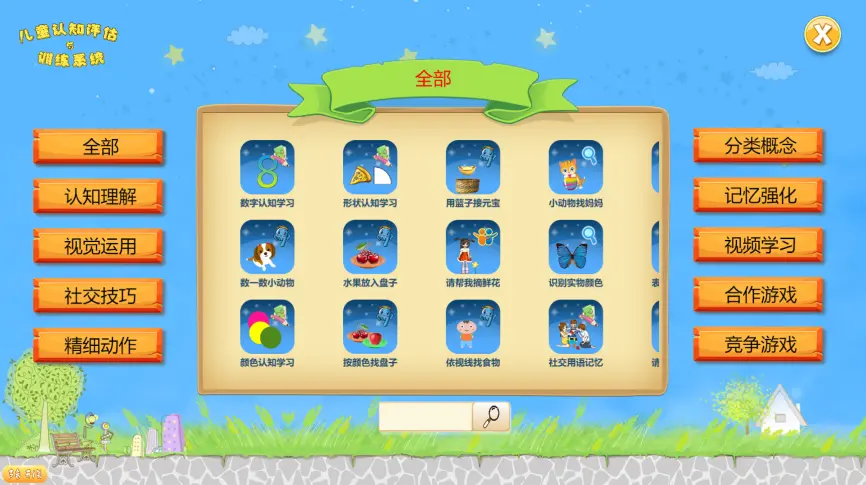
9 major training dimensions
Social skills, cognitive understanding, visual application, classification concepts, competitive learning, cooperative learning, immediate reinforcement, fine motor skills, memory reinforcement, and accompanied by multiple video learning resources
Multi-modal training mode
Through multimodal training modes such as vision, hearing, and touch, targeted training is conducted in areas such as observation/memory ability, thinking/reasoning ability, and hand-eye coordination ability. Games are used as a medium to provide diversified training experiences, with difficulty levels automatically adjusted according to children's ability levels. This comprehensive training enhances children's attention concentration, persistence, and flexibility, thereby improving their overall attention level.
Pay attention to quantitative evaluation
Addressing issues such as attention deficits in children, we quantitatively assess children's attention span, attention stability, attention allocation, attention shift, and other characteristics during human-computer interaction. Based on these assessments, we provide a quantitative analysis report and develop a scientific and personalized training program accordingly.
Evaluation-Recommendation-Training Closed Loop
The game training generates personalized training schemes based on evaluation results and supports customized training plans. The system automatically records and saves each training result, facilitating longitudinal effect comparison and scientifically tracking growth trajectory.
Multi-user management
The system provides flexible multi-user management functions, tracks and records children's attention assessment and training data, establishes a learning and growth path, and helps children continuously improve. The multi-platform solution adapts to various usage scenarios such as schools, institutions, and families.
Intelligent evaluation and training management software
Graphical Comprehensive Assessment Report
Through immersive gamification experiences and scale assessments, a comprehensive assessment report containing various forms such as bar charts, histograms, indicator charts, and detailed data tables is automatically generated, making the current ability status clear at a glance.
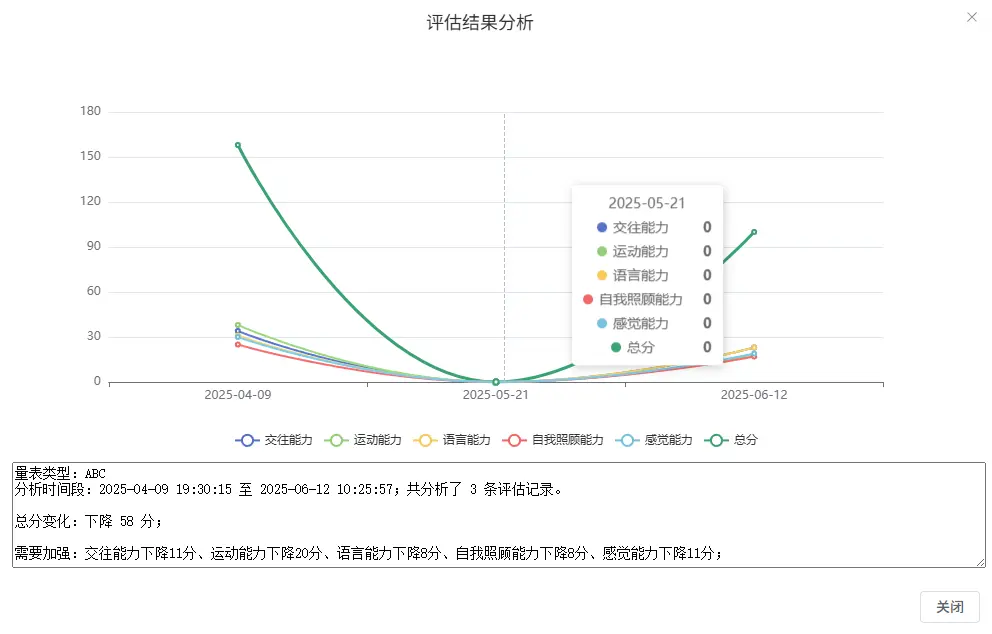
Visualization of evaluation result trends
Historical evaluation records are presented in the form of line charts, clearly showing the changing trends of different ability dimensions, with a direct comparison between before and after training.
Intelligent intervention suggestions
Based on the evaluation data, intelligently generate personalized evaluation and intervention suggestions, and automatically recommend suitable training games, ensuring a concise and efficient process from evaluation to intervention.
Flexible deployment and collaboration
Breaking the constraints of time and space, aligning content precisely with teaching objectives, supporting collaborative adjustments between parents and teachers, and integrating professional rehabilitation into daily life.
Academic support and product qualification
https://content-static.cctvnews.cctv.com/snow-book/video.html?item_id=10841095328426765315&t=1787637725073&toc_style_id=video_default&share_to=wechat&track_id=62114ba0-b4bf-4237-82dd-6115530f5ccd&sessionid=
Academic support
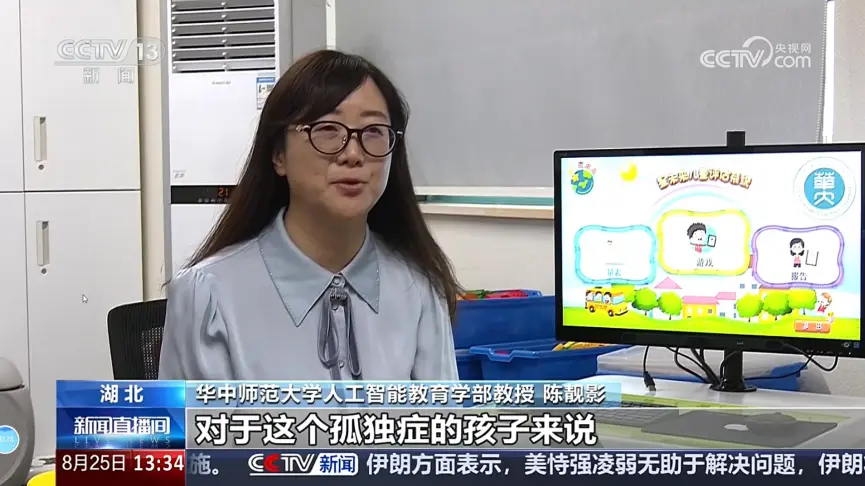
The system-related technology originates from the Special Education Informatization Research Center of Central China Normal University. Established in collaboration with the National Digital Learning Engineering Technology Research Center and the Department of Special Education at the School of Education, Central China Normal University, the center is led by Chen Jingying, a distinguished professor and Chu Tian Scholar. It has long focused on autistic children as its primary research subjects, conducting fundamental theoretical research and technological development in special education informatization. The team has published over 200 papers, including more than 70 indexed by SCI/SSCI/CSSCI, secured 27 authorized invention patents (including 1 international patent), obtained 49 software copyrights, and received accolades such as the First Prize of Hubei Provincial Science and Technology Progress in 2020 and the Hubei Provincial Basic Education Teaching Achievement Award in 2025
Scope of application
It is suitable for pediatric patients with attention deficit hyperactivity disorder and mild cognitive impairment, and is used for assessment and auxiliary rehabilitation training.